
What is VI (Variability Index), and why is it important?

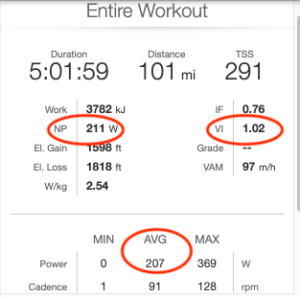
VI stands for Variability Index or the ratio between your Normalized Power (NP) (aka – the true cost of the effort) to your average power (AVG). Generally, the higher the VI, the less steady the ride was (more variable), which potentially may mean it has more anaerobic efforts mixed in. This metric can be visualized by how “spikey” the power data is.
One of the best ways to think about variability is by race type and demands. A mountain bike race, with lots of short hard high, power efforts combined with undulating terrain, is a highly variably effort. These events can have a VI ratio of 1.13 to 1.50. A criterium-style race can also be highly variable, based on the short steep power outputs in corners and pack dynamics, and can range from 1.06 to 1.35. In contrast, a perfectly flat iso-power (constant load) or flat time trial can range from 1.00 to 1.04. For a long-course triathlon, I typically expect to see VI’s ranging from 1.01 for a flat course and up to 1.07 for a hilly course. Another way to look at VI is to imagine you are locked into ERG mode at a specific wattage and just rode there for an hour or so. Same cadence, same power for the entire ride, and your NP and AVG will match, resulting in 1.0. or perfectly steady-state.
So why is VI important?
VI tells us something about the race demands. If we know that a mountain bike race or a cyclocross race is highly variable, with numerous changes in power, we can build training around it. In fact, we can use this information to dive deeper into the power data, determine the frequency, duration, and magnitude of the efforts, and duplicate that in training. On the other hand, if we know the race requires a steady output to succeed (low VI), as in a time trial or long course triathlon, we then realize the need to practice holding stable over extended periods at our goal race power.
Example of a low VI on a ride, note the relationship of NP to AVG
BTW – this does not mean every single ride and workout will match the VI of your race discipline, just that you should consider this element when developing your plan and accommodate it during race-specific workouts. Your longer aerobic rides are the perfect time for triathletes to practice this!
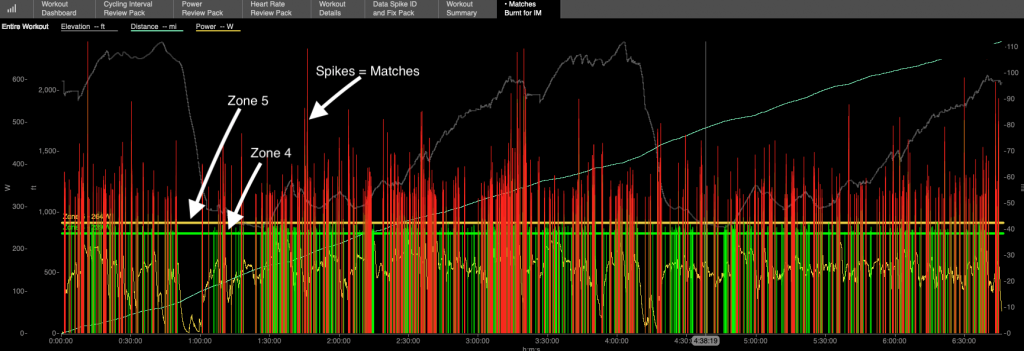
VI is also important in understanding your riding style and the data post-ride. If the goal of the ride was to pace steadily and minimize VI, you could use that value to determine if you did or did not hit the target. A high VI ride may mean you burned a lot of matches (very hard efforts) and then struggled later in the ride or had a poor run off the bike as a result. For long-course triathletes and time trialists, this can be examined by looking at power spikes (or forays) above your goal power to check for these matches. For example, for Ironman athletes, I look at spikes above threshold (zone 4) for completed races, which can help determine how disciplined the effort was paced and the potential performance impact.
Numerous spikes above threshold during a full IM race, impacting run performance
80+ mile steady ride with a VI of 1.02
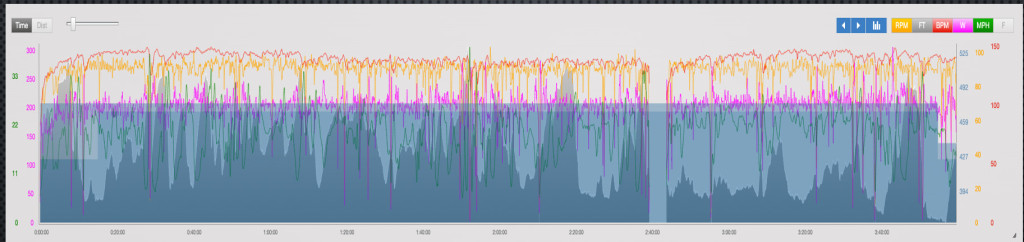
Each of those spikes or surges adds up over the duration of the ride, raising variability and then physiologically “costing” the athlete more due to the higher normalized power achieved vs. holding a more steady effort. Once totaled, it can be determined if the athlete spent considerable time at or above their goal power, in turn creating extra fatigue and potentially higher glycogen utilization. For triathletes who will still need to run a half or full marathon off the bike, the consequences are that run performance and even fueling are now likely impacted. As a coach, my experience has repeatedly shown that the impact of those spikes is a silent killer of an athlete’s run performance.
What impacts VI?
There are a number of factors that impact VI, including terrain, weather, gearing, and pack dynamics (riding in a group). Group riding, by nature, may have lots of surges or time spent drafting. A hilly course or rolling course will see times at higher and lower power due to terrain. Routes that have lots of stops in them will also impact VI, as well as pedaling characteristics. Riders who coast a lot or don’t change gears often (typically big gear mashers) will contribute to higher VI’s.
How to minimize VI?
To reiterate, a high VI is not bad if that is what your race discipline requires, but if your goal is to minimize it, as in triathlon, it is essential to understand how to reduce it. Arguably the most common reason for a high VI is not shifting enough, which may also mean you have the wrong gearing for a hilly course. If you are pushing a big gear at a low cadence, generating big spikes in watts to get over the climbs, it may be time to rethink what you are running for either your chainring and/or your cassette. For most triathletes, a 50-tooth chainring is likely the biggest any Age-Group athlete will need for any course. Paired with many modern rear derailleurs, which can allow for the largest cassette cog to be a 32 or even a 36-tooth will give you a massive range of options for shifting. Making this change may be the key to helping you maintain your cadence and reduce the tendency to spike the power on the hills.
The second element to consider in minimizing VI is to pay attention to your pedaling style. While terrain can impact variability, it is less influenced by steady trends in power vs. sharp peaks in power. Those power spikes can occur more often than you realize, so it is essential to minimize them when the terrain goes up, in corners, or when passing other riders. One of the best ways to keep track of your power is to display 3-sec power averaging on your bike computer, along with cadence. Use that information to stay within 10 watts or 5% (depending on the course) of your target power and cadence. Regarding cadence, while more research needs to be done in regards to what range may reduce VI the most, the best bet is to keep your self-selected cadence steady and minimize time coasting.
Remember that lowering your VI may take some time and practice, but it can be improved if you work at it. Try it over the same course for a few weeks, and see if you can’t lower your VI. You may want to start with a flatter route initially and then move to some gentle rollers before tackling bigger climbs. Stay smooth, focus on steady trends in power and cadence, and reduce those surges!